Most office jobs, whatever the title on the door says, come down to one unglamorous task: pulling a piece of information out of one system and putting it into another. A number leaves the CRM and lands in a spreadsheet. A call gets summarized from a notes app into a project tool. A client detail gets typed into three different platforms before lunch, none of which talk to each other. This is the actual daily work for a huge share of knowledge workers, and it has almost nothing to do with the skill they were hired for.
Employers are now trying to fix this with AI, and the first honest step is uncomfortable: watching people work closely enough to see where the process really breaks down. That is what process mining and task mining do. Done well, they surface the real bottlenecks and the tacit knowledge holding a team together. Done badly, they slide into surveillance, and in parts of Europe that slide now comes with a legal price tag attached.
This is a guide to doing it the first way. What process mining and task mining track, why the target should be tacit knowledge rather than raw activity, what the law currently requires, and where the humans should be spending the time AI frees up instead of the app-switching that is quietly driving a lot of the burnout in white-collar work right now.
The two terms get used interchangeably in vendor marketing, but they look at completely different layers of a business. Process mining reads the event logs your enterprise systems already keep: timestamps and transactions from the CRM, the ERP, the helpdesk platform. It reconstructs the real path a piece of work took from start to finish, workarounds included, often exposing how far the actual process has drifted from the one written in the handbook. Task mining works one level down. It watches the desktop itself: which window is in focus, what gets clicked, what gets copied and pasted where. Process mining tells you a lead takes eleven days to move from marketing to a closed deal instead of the three the process map promises. Task mining tells you why: a rep is manually retyping the same contact fields into four systems for every single lead.
If this sounds like the workflow mapping we recommend at Orbflo before automating anything, that's because it is the same instinct applied at enterprise scale: see how work really moves before you touch it with software. We wrote about the manual version of this in how to map your business workflows before you automate them. Process and task mining are what happen when a company is too large to do that mapping by hand, and reaches for system logs instead of interviews.
The point of tracking work isn't to build a heat map of who's busiest. It's to find the tacit knowledge that never made it into a manual: the workaround a five-year employee performs without thinking and would struggle to explain if you sat them down and asked. Chemist and philosopher Michael Polanyi described this gap in a single line that economist David Autor later built into a working theory of automation and employment: "we know more than we can tell," now generally referred to as Polanyi's Paradox.
Tacit knowledge is contextual intuition: knowing which client really means "urgent" when they write "whenever works," knowing which refund exception is fine to grant on the spot and which one needs a manager. Nobody can fully narrate rules like these, which means nobody can fully hand them to a software engineer to codify either. That is the real reason so many "simple" tasks keep resisting automation even as objectively harder-looking ones, like drafting a legal summary or running a statistical model, fall to AI with little friction. The tasks that survive aren't the intellectually hardest ones. They're the ones nobody can fully explain.
Deploying AI on top of an unstandardized process scales the inconsistency instead of saving time. If three people run a task three different ways, an algorithm trained on all three doesn't know how to pick the best one andit learns to reproduce all three errors at volume. The sequence that avoids this starts with people, not software.
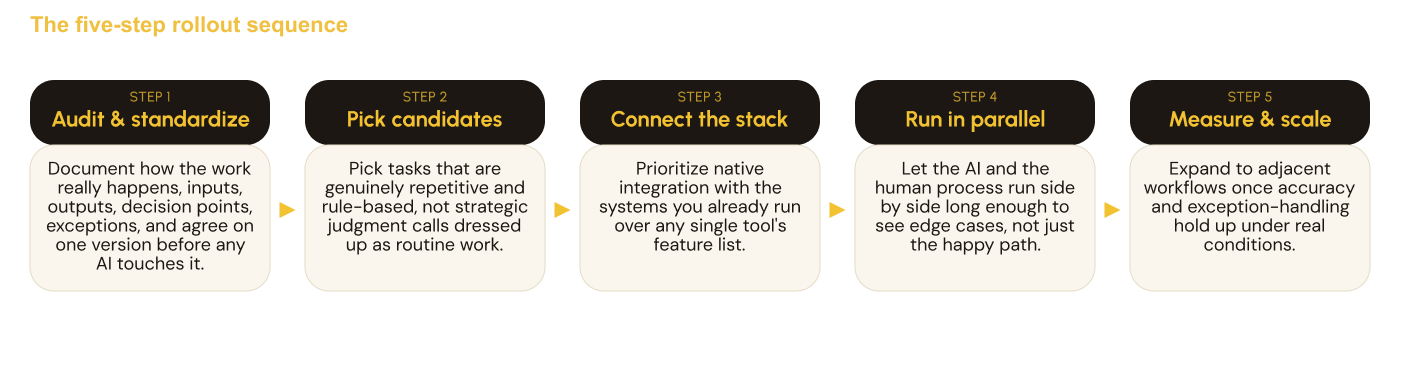
The stage most companies skip is the first one, because it's the least technically interesting. It's also the one that determines whether everything after it works.
Under the EU AI Act, AI systems used for candidate screening, task allocation, productivity tracking, or performance evaluation sit in Annex III as High-Risk systems, which brings a specific set of obligations: documented risk management, human oversight, and clear disclosure to workers before deployment. The original deadline for these obligations was 2 August 2026. The EU's Digital Omnibus agreement pushed it to 2 December 2027, so if you assumed you'd already missed this window, you haven't, but the requirements themselves aren't going away.
Separately, and already in force, Article 5 of the Act draws a hard line that has nothing to do with that later deadline: it prohibits AI systems from inferring a worker's emotions from their voice, video, or biometric signals in the workplace, full stop, with narrow medical and safety exceptions. Any tool that scores stress, fatigue, or "sentiment" from an employee's tone or facial expression is already off the table in the EU, regardless of how the rest of the deployment is staged.
Consent doesn't solve this either. Under GDPR, employee consent is generally treated as invalid as a legal basis for workplace monitoring, because the power imbalance between employer and employee means consent can rarely be considered freely given. Employers instead need a documented legitimate interest basis, tested through a proportionality assessment, alongside a formal Data Protection Impact Assessment before systematic tracking begins. In Germany specifically, works councils hold binding co-determination rights over any technical system capable of monitoring employee behavior or performance under BetrVG Section 87, and deploying task mining software without their agreement has repeatedly ended in injunctions rather than insight.
Even where the law allows it, the tooling itself creates friction. Task mining platforms that require an employee to manually start and stop a desktop recorder generate two problems at once: incomplete data when people forget, and resentment over the sense of being watched when they remember. A tracking program that damages trust faster than it produces insight is a net negative cost.
Sources for the table above: Gibson Dunn, Future of Privacy Forum, gStride, and Luther Rechtsanwaltsgesellschaft.
None of this means the exercise isn't worth doing. Process mining replaces manager guesswork and self-reported surveys with an objective record of what happened, which is a different thing from what the org chart says should happen. It surfaces the workaround that three different teams have quietly built around a broken handoff, the kind of thing nobody puts in a status update because it's just "how we do it here." And once the repetitive, well-defined slice of a workflow is genuinely automated, the freed-up time is real: the same swivel-chair work that used to eat someone's morning stops being a line item on their day at all.
It also sets up something the law is going to require anyway. Human oversight of high-risk AI, mandated under the EU AI Act's provisions on human oversight, only works if someone in the building genuinely understands how the process ran before AI touched it. Process mining, done transparently, is what makes that reviewer qualified rather than decorative.
There's a second, older paradox worth knowing before deciding what to automate. Moravec's Paradox observes that high-level abstract reasoning, the kind involved in statistical analysis or playing chess, is comparatively cheap for a machine to perform, while basic sensorimotor skill, situational awareness, and reading another person accurately require far more computational effort than intuition suggests. It's the reason a model can draft a competent legal memo in seconds but still can't reliably tell whether a client on a call is satisfied or just being polite.
The right-hand column is where judgment, governance, and creativity live, and it's also where the value is moving. As automation absorbs the routine sub-tasks in a role, it raises the price of the complementary human work that's left, an effect David Autor has documented across decades of labor-market data. The people worth investing in aren't the ones who can out-type a model. They're the ones the model still can't stand in for.
Here's the part that gets lost in most AI rollout plans: a huge amount of what currently eats a knowledge worker's day isn't judgment work at all. It's moving context from one specialized tool to another, a role that's less "employee" and more human API. Two decades of uncoordinated software adoption have quietly made this the default shape of office work, and the data on what it costs is not subtle.
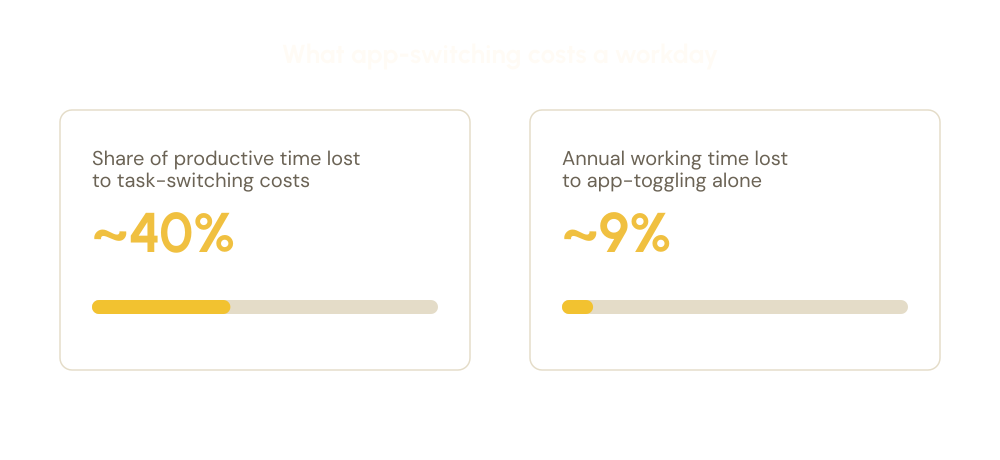
Sources: American Psychological Association, Multitasking: Switching Costs; Harvard Business Review, How Much Time and Energy Do We Waste Toggling Between Applications?
The Harvard Business Review figure behind that second bar is the one that tends to stop people: the average digital worker switches applications or websites close to 1,200 times a day, moving between roughly ten apps on a typical day according to Asana's Anatomy of Work research. Each switch isn't free. UC Irvine researcher Gloria Mark's long-running attention studies put the cost of a real interruption at roughly 23 minutes to fully regain focus, and found that the average time spent on any single screen before switching away has fallen to about 47 seconds, down from two and a half minutes when she first measured it in 2004.
This is the real argument for centralizing workflows rather than adding another specialized app to the stack. Every new point solution solves one narrow problem and creates a new handoff for a human to manually bridge. A person's job was never supposed to be "context router." When AI takes over the routing, that's not a headcount story, it's a burnout story with a fix attached.
The organizations getting this right aren't asking "which jobs does AI replace." They're asking which parts of every job were never really the job, and handing those parts over. Three shifts follow from that, and they apply to almost anyone doing knowledge work today.
The first is a move from executing tasks to designing and auditing the workflows AI now runs, effectively becoming the person who understands how a process works well enough to catch it failing. We covered what this reskilling looks like in practice in how to upskill your whole team on AI without spending a cent. The second is stepping into the human-in-the-loop reviewer role that regulation now makes mandatory for high-risk decisions, a role with real standing precisely because it can't be automated away by the same law that created it. The third is simply spending more of the day on the things in that right-hand column above: judgment calls, governance decisions, and the creative and relational work that was always the actual point of hiring a person in the first place.
Standardize before you automate anything. If three people run a process three different ways, fix that first, in writing, before software touches it. Build in slack rather than optimizing it away: a workflow with zero spare capacity looks efficient right up until an edge case arrives, at which point it has nowhere to absorb the shock and the whole thing backs up. And treat compliance as the first step of the project, not the last item before launch.
In the EU, consent generally isn't the legal basis employers should rely on, because the power imbalance in an employment relationship means consent can rarely be considered freely given under GDPR. The standard route instead is a documented legitimate interest, tested through a proportionality assessment and a formal Data Protection Impact Assessment, plus prior agreement with worker representatives where they exist, such as works councils in Germany.
Time tracking records how many hours were spent on something. Process mining reconstructs the actual sequence a piece of work took through your systems, including every workaround and variant, by reading event logs already generated by tools like your CRM or ERP. The goal is redesigning a broken process, not billing or attendance.
The evidence points to task automation rather than whole-job elimination. Technology tends to strip the routine, codifiable pieces out of a role while increasing the value of the tacit-knowledge work that's left, which is why the roles that survive tend to concentrate around judgment, relationships, and creative direction rather than shrinking altogether.





The AI Operating System Scorecard is a diagnostic tool that measures whether your business is structurally built to make AI compound, across nine dimensions including how decisions get made, how clearly your processes are defined and how your team is using and integrating AI.
The output is a clear view of where your biggest leverage gaps are and where to focus first.


One practical AI operating-system insight bi-weekly.
No fluff, no spam.

© 2026 AV Ventures Limited trading as Orbflo | All Rights Reserved