
Redesign how work happens.
In four weeks we take a high-value part of your business and rebuild it with better processes, automation and AI. A better operating system.
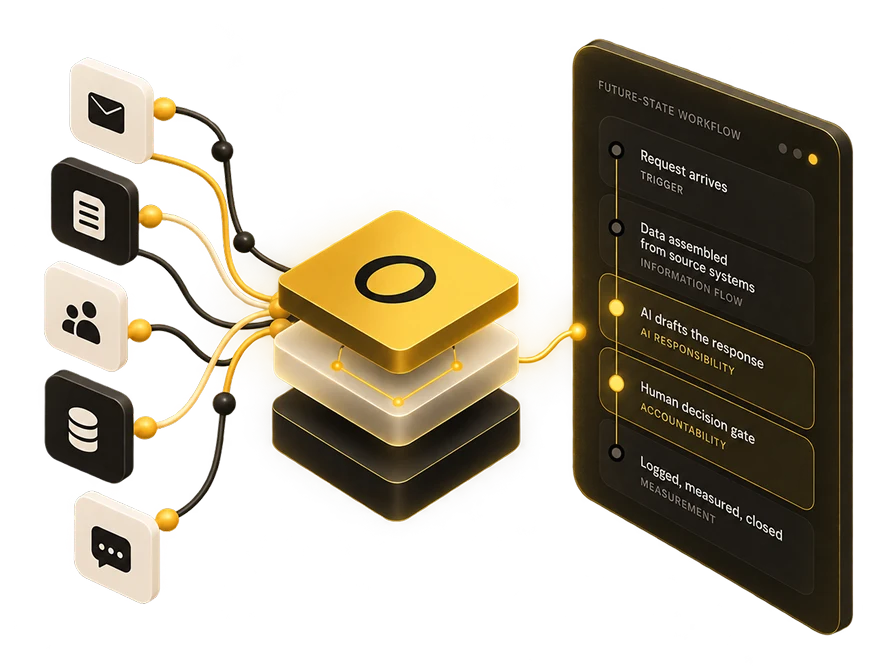

Most AI implementation programmes fail from the first question they ask.
Ask the wrong one and you start buying more tools. Ask the right one and you change how the work performs..
What can we automate?
It takes the process as given. So the handoffs, the chasing and the rework all survive. Only faster, and now with an additional licence fee attached and using more tokens than necessary.
How should this work if we designed it today to create business value?
Answer that first and the technology decisions are easier. You already know what the work is meant to do, who owns it, and what good looks like.
Two to three high-value workflows, redesigned and running.
Over 4 weeks we redesign the workflows and build the operating infrastructure required to run them differently. Depending on your priorities, that could include:
Revenue
Lead qualification
Account research
Proposal generation
Sales follow-up
CRM management
Process Clarity
Client onboarding
Customer requests
Support triage
Reporting
Renewals
Delivery
Project initiation
Resource allocation
Quality assurance
Status reporting
Knowledge management
Internal Operations
Approvals
Reporting
Decision-making
Information routing
Meeting workflows
We don't automate broken processes.
Every workflow moves through five gates, in order. Automation and AI come last, after the work has earned the right to exist.
Eliminate
What work shouldn't exist at all?
Simplify
What complexity can we remove?
Systemise
What needs clear rules, ownership and data?
Automate
What deterministic work can systems handle?
AI-enable
Where does intelligence, judgement or generation create genuine leverage?
Building an operating model that works for an AI-powered future
Map current workflows.
We start from how the work runs today. Understanding how the full workflow works, going behind how the process document says it runs.
Identify bottlenecks, decisions, handoffs and systems
Surface unnecessary work
Define baseline performance
Design the future-state AI-native workflows.
Every future-state workflow is specified end-to-end, working closely with your team, and signed-off before anything gets built.
Triggers
Automation
Information flows
AI responsibilities
Human decision gates
Exception handling
Ownership
Measurement
Configure the agreed systems, automations and AI workflows.
Build happens against the agreed design.
No surprises, no scope drift.
Configure systems, automations and AI workflows
Connect the tools and data the process needs
Test the new workflows with the team.
The Sprint ends with the workflow live,
owned and measurable.
Resolve edge cases
Document the operating model
Establish ownership and measurement
Train the people who will run and improve it
Six tangible deliverables. Not a slide deck.
2-3 redesigned workflows
Current-state and future-state operating maps.
AI + Automation Architecture
How systems, agents, automations and humans interact.
Working Implementation
The agreed workflows configured and tested within the scope of the Sprint.
Decision & Governance Model
Where humans remain accountable and where work can safely run autonomously.
Operating Playbooks
Documentation your team can actually use.
Performance Baseline
Metrics against which improvement can be measured.
One fixed price.
One four-week engagement.
Following the Sprint, Orbflo can continue supporting implementation and optimisation through ongoing AI Operating System Advisory.
- 2–3 workflows redesigned and built
- AI + automation architecture
- Decision & governance model
- Operating playbooks + performance baseline
- 30-Day Optimisation Plan
Your team shouldn't have to work harder because your business is growing.
Build an operating system that scales instead.
30-minutes call. We'll tell you if a Sprint isn't the right fit.


© 2026 AV Ventures Limited trading as Orbflo | All Rights Reserved
