
Global organizations spent $252.3 billion on AI in 2024. That number roughly doubled to an estimated $1.5 trillion in 2025, and Gartner now expects it to clear $2 trillion in 2026. In the US alone, businesses put $37 billion behind AI initiatives last year. In the UK, enterprises are estimated to have spent £320 billion.
None of that spending is buying what boards were promised. Roughly 88% of organizations report using AI regularly in at least one business function, but 62% haven’t started scaling it enterprise-wide. The 70% failure rate that gets quoted in most trend pieces actually understates the problem: depending on how “failure” is defined, real abandonment rates run from 70% to 95%.
MIT’s NANDA initiative, built on interviews with 150 executives, a survey of 350 employees, and analysis of 300 deployments, found that 95% of enterprise generative AI pilots generate no measurable financial return. The RAND Corporation, working from interviews with data scientists and engineers across dozens of AI efforts, put the number at over 80% failing to reach meaningful production, roughly double the failure rate of ordinary IT projects. Neither study blames the models. Both point to the same root cause: organizations that never built the readiness to absorb what AI actually requires of them, meaning fragmented data, uncoordinated workflows, rigid reporting lines, and no one clearly accountable for the outcome.
This isn’t an article about immature technology. Frontier models today are more capable, cheaper to run, and easier to integrate than they were even a year ago. What hasn’t kept pace is how companies operate: the workflows, decision rights, and data plumbing that determine whether a capable model ever gets to do useful work. Buying a better tool doesn’t fix that. Redesigning how the business runs does, and almost none of the failure statistics above are measuring a shortage of good tools.
The following table lines up how six major research bodies have measured the same gap using different methods. The spread is wide, but the direction is clear: every serious study agrees that most AI investment right now produces little to nothing.
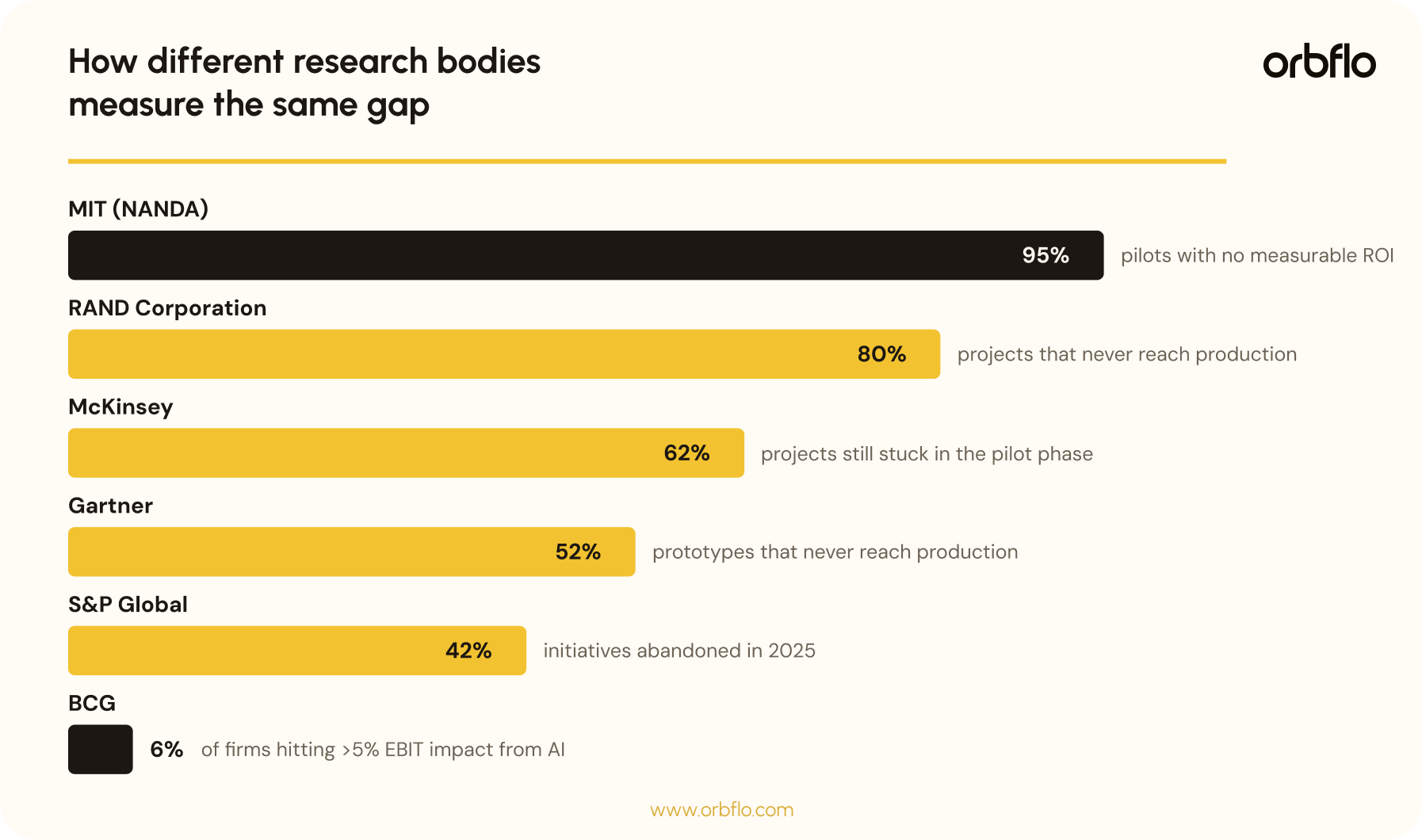
The uncomfortable part is that the gap is widening, not closing, even as the technology improves. Spend nearly doubled from 2024 to 2025 and is on pace to nearly double again by 2026, but the abandonment rate S&P Global tracks jumped from 17% to 42% over that same stretch, the sharpest single-year increase in the data. More money is chasing the same unsolved organizational problems, which means more of it is going to waste. That’s the case for reading the rest of this piece as an operating problem rather than a shopping list: the fix isn’t a better model or a bigger budget, it’s building the readiness that turns spend into results.
Getting a prototype to work is the easy part. The gap that actually kills initiatives sits between “it works in the demo” and “it runs unattended in production, at scale, under audit.” A rigorous 18-month tracking study of 100 enterprise generative AI pilots across regulated and high-tech sectors mapped that gap in numbers that are hard to argue with. Out of 100 funded pilots, 91 were killed before they ever reached production. Of the nine that made it, seven were killed within twelve months. Two survived.
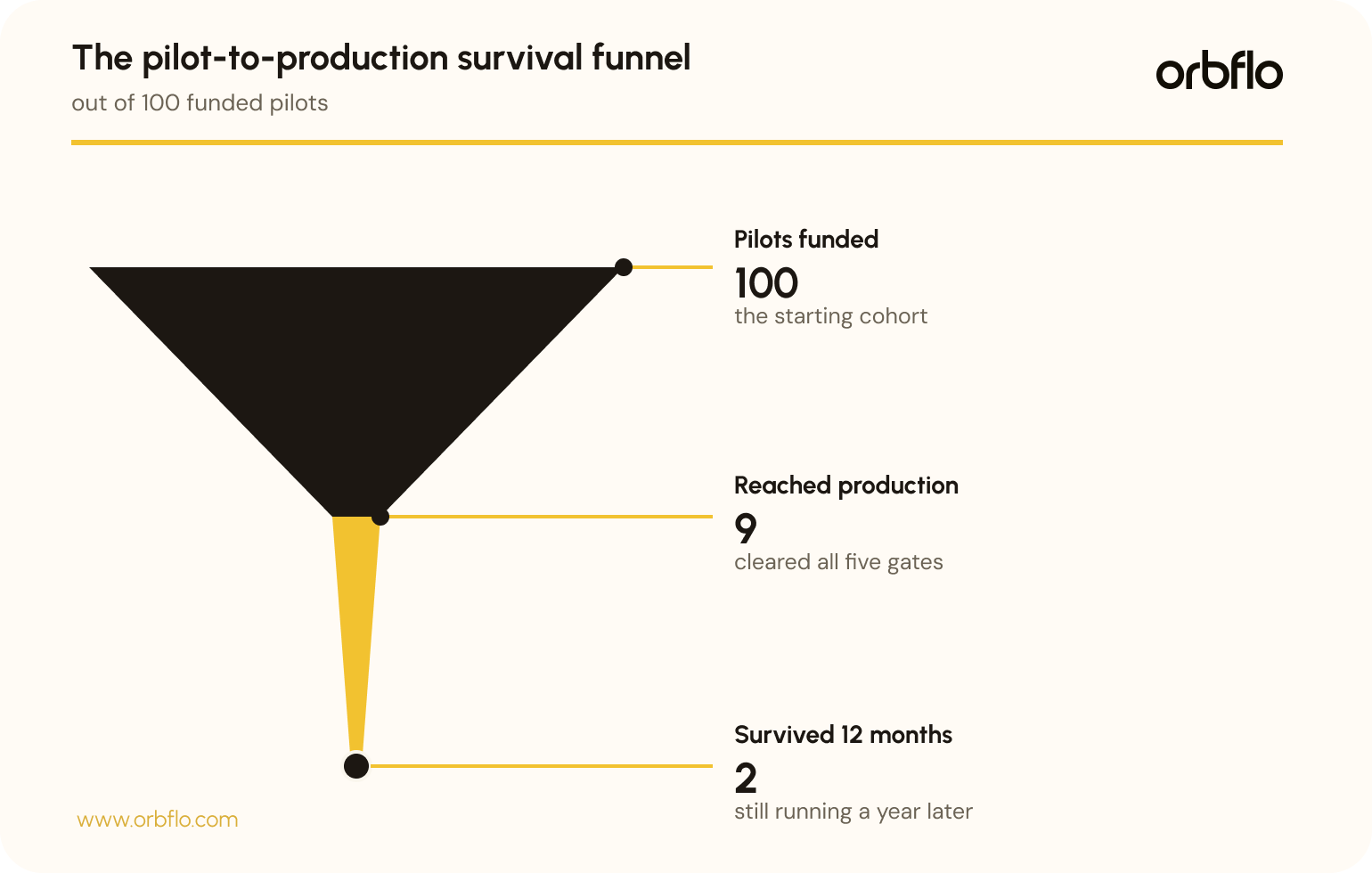
A 2% survival rate from initial funding sounds brutal, and it is. It also isn’t random. Five predictable gates account for most of the 91% that die before production, and every one of them is a gate teams could plan for if pilots weren’t designed to skip past them.
The security and InfoSec gate. Pilot teams build fast, often with personal API keys, unapproved repositories, and customer data flowing through endpoints nobody vetted. When InfoSec finally reviews the system for production clearance, they find violations of SOC 2, GDPR, or basic audit-trail requirements. Retrofitting compliance into a finished application is expensive work, and teams are routinely quoted six-to-nine-month rebuild timelines that exhaust whatever budget remained. The risk here isn’t theoretical: security researchers who probed the “Olivia” hiring assistant McDonald’s used through Paradox.ai found the admin panel secured with the password “123456” and no multi-factor authentication.
The data access architecture gate. Proof-of-concept work usually runs on static, hand-cleaned sample data exported into a notebook. Production requires live feeds pulled from Snowflake, Salesforce, and legacy ERP systems, wired through role-based access control, encryption, and retention schedules that actually hold up under audit. That plumbing takes months. By the time it’s done, the business case that justified the pilot has often moved on, and the project dies with it.
The compounding integration tax. A pilot deployed as a standalone tab is not a production system. Getting AI into the tools employees actually use daily means wiring it into single sign-on, observability stacks like Datadog or Splunk, CRM systems, and alerting. Each connection adds development time, and an eight-week pilot routinely turns into a multi-month engineering slog that outlasts the patience of whichever executive sponsored it.
Unviable cost-to-serve economics. Ten internal users querying a model 50 times a day costs almost nothing. The same usage pattern at 5,000 users runs into tens of thousands of dollars a month. Few teams model that curve before they build, so when the CFO finally sees the production business case, the unit economics don’t clear the bar and the project gets vetoed.
Model dependency risk. Pilots are frequently built as hard dependencies on one specific model snapshot. When the provider deprecates it, changes pricing, or adjusts safety filters, prompts break. Without a model-agnostic routing layer designed in from day one, that failure becomes an emergency migration that halts production and burns through whatever budget was left for anything else.
Underneath these five gates sits a strategic error that shows up before any of them: picking the wrong kind of use case to begin with.
Roughly 70% of Fortune 500 companies have deployed general-purpose systems like Microsoft 365 Copilot. Their impact is real but diffuse, spread across so many employees that it rarely shows up clearly in revenue or margin. Vertical, domain-specific AI tends to do better precisely because it’s narrow: it runs on proprietary data against one well-defined workflow, which makes its output easy to measure. The research advisory firm Lux Research built “Luxer,” a custom assistant trained on its own proprietary research database, and saw a 3.6x increase in how fast users could schedule work. More broadly, purchasing a vetted, specialized vertical AI product succeeds about 67% of the time, while building the equivalent system internally succeeds only around 22% of the time. Internal teams tend to over-invest in model tuning and under-invest in the infrastructure that actually determines whether the thing scales.
This is also where company size changes the calculation. A large enterprise can absorb a failed internal build and try again next quarter. A smaller organization usually gets one real attempt at this before the budget or the appetite runs out, which makes the horizontal-versus-vertical choice less about ambition and more about survival. Picking one workflow that’s actually broken, mapping how work moves through it today, and buying a narrow solution built for that exact problem will beat a broad internal AI initiative almost every time, at any company size, but especially at smaller ones.
The single biggest technical reason AI projects rarely move to production is that most organizations don’t have data built for AI in the first place. Traditional data management is optimized for structured, predictable datasets meant for retrospective reporting. AI needs something different: data that’s dynamic, representative of edge cases, and governed in a way that can keep up with changing rules. Gartner now projects that, through 2026, organizations will abandon 60% of AI initiatives that aren’t backed by genuinely AI-ready data, and separately finds that at least half of AI proof-of-concepts get scrapped for poor data quality, weak risk controls, or unclear business value.
The sensitivity here is not abstract. Controlled testing shows that just 20% pollution or noise in a training dataset produces a 10-percentage-point drop in model accuracy, the kind of effect researchers demonstrated on the IBM Telco Customer Churn dataset. Despite that sensitivity, most enterprise data sits in exactly the wrong shape for this: less than 1% of total enterprise data is actively used in any AI model, with the rest locked away in PDFs, legacy databases, and repositories nobody ever tagged.
A 2025 survey of Chief Data Officers put a number on how bad the gap actually is.
The knock-on effects compound. Organizations with genuinely AI-ready data foundations report a 26% improvement in overall business outcomes; those without one face a 60% abandonment rate on their AI initiatives. Separately, 74% of companies say poor data integration is the single biggest thing standing between them and scaled AI value. The organizations actually winning here do the unglamorous work first: they redesign the data pipeline before they pick a modeling approach, not after.
There’s a literacy problem sitting on top of the infrastructure problem. DataCamp’s research found that organizations with strong data literacy programs see 35% higher productivity and 25% better decision quality. Yet while 83% of business leaders call data literacy a critical skill, only 28% have actually built it across their workforce, which goes a long way toward explaining why so many teams can’t spot biased or low-quality data before it goes into a model.
This is also why the data-access gate described earlier keeps killing pilots that looked fine in testing. A proof-of-concept built on a clean, hand-picked export will always perform better than the same model running against the real, messy, partially-tagged data an organization actually has. The gap between those two states isn’t something a better prompt or a bigger model fixes. It closes with the unglamorous work of tagging, structuring, and governing the data before anyone builds on top of it, which is exactly the kind of work that rarely gets funded until a pilot has already failed once for lack of it.
Some of the highest-profile AI failures on record trace back to exactly the gaps described above: no volatility guardrails, biased training data, or missing deployment controls. Each case below points to a specific, fixable operational failure.
Two of these are worth a closer look because they show up in almost every failure post-mortem in different clothes.
Zillow’s home-buying algorithm was tuned for a housing market that behaved the way it always had. When the pandemic broke that pattern, the model had no way to notice, no confidence threshold to trigger a pause, and no human checkpoint built into the loop. It kept buying at prices the market could no longer support. By November 2021, Zillow was sitting on roughly 7,000 unsold homes worth about $2.8 billion, wrote down $407.9 million in inventory value for the year on top of $71.2 million in impairment and restructuring costs, and cut about a quarter of its workforce, roughly 2,000 jobs, as it shut the business down entirely. This is what happens when a model is optimized for a world that no longer exists and nobody built in a way to catch that.
IBM Watson for Oncology failed for a quieter but more instructive reason. Internal IBM documents obtained by STAT News showed the company’s own medical specialists and hospital customers flagging multiple examples of “unsafe and incorrect” treatment recommendations while IBM was still marketing the product worldwide. The root cause traced back to training: the system was built largely on a small number of synthetic, hypothetical cases developed with a handful of specialists at one cancer center, rather than on the messier reality of actual patient outcomes across different populations. The lesson generalizes well beyond healthcare: a model is only as good as how closely its training data resembles the actual conditions it will operate in, and synthetic data is a shortcut that shows up later as a liability.
The Amazon and Knight Capital cases point to a different failure mode: process, not training data. Amazon’s recruiting model wasn’t fed bad labels on purpose. Reuters first reported that it learned from a decade of hiring decisions that happened to be male-skewed, and nobody ran a bias audit before putting historical data to work, so the model simply reproduced the pattern it found. By the time engineers noticed it downgrading resumes that mentioned “women’s chess club” or graduates of all-women’s colleges, the bias was baked in deeply enough that Amazon scrapped the project in 2017 rather than try to fix it. Knight Capital’s failure had nothing to do with bias and everything to do with release discipline: a software deployment left an old, dormant test routine live on one production server, bound by mistake to the same settings as new code, and in about 45 minutes the resulting flood of unintended trades cost the firm $440 million. Neither failure required a smarter model. Both required a control that already existed as a known best practice and simply wasn’t enforced.
Apple Card and Air Canada round out the pattern from the customer-facing side, though they landed very differently once regulators actually looked. After viral complaints in 2019 that the Apple Card’s underwriting algorithm gave lower credit limits to women than to men in the same household, New York’s financial regulator opened a formal investigation, analyzing underwriting data across roughly 400,000 applicants. It ultimately cleared Goldman Sachs of fair-lending violations, but still criticized the company for how poorly it could explain individual credit decisions to customers when the complaints first surfaced, the kind of gap that turns a defensible model into a viral controversy anyway. Air Canada had no such defense available: its support chatbot simply invented a bereavement-fare policy that didn’t exist and told a grieving customer it applied to him. A tribunal held the airline liable for what its own chatbot said, rejecting the argument that the bot was a separate legal entity. Both cases share the same underlying gap: a non-deterministic system was given a customer-facing or regulated role without a deterministic fallback or a fast, clear way to explain what it did and why.
BCG’s research, drawn from work across hundreds of enterprise AI rollouts, found that the value organizations get from AI splits roughly 10% from the algorithms, 20% from the technology and data infrastructure, and 70% from people and process: how work actually gets redesigned, how staff are retrained, and how the operating model itself changes.
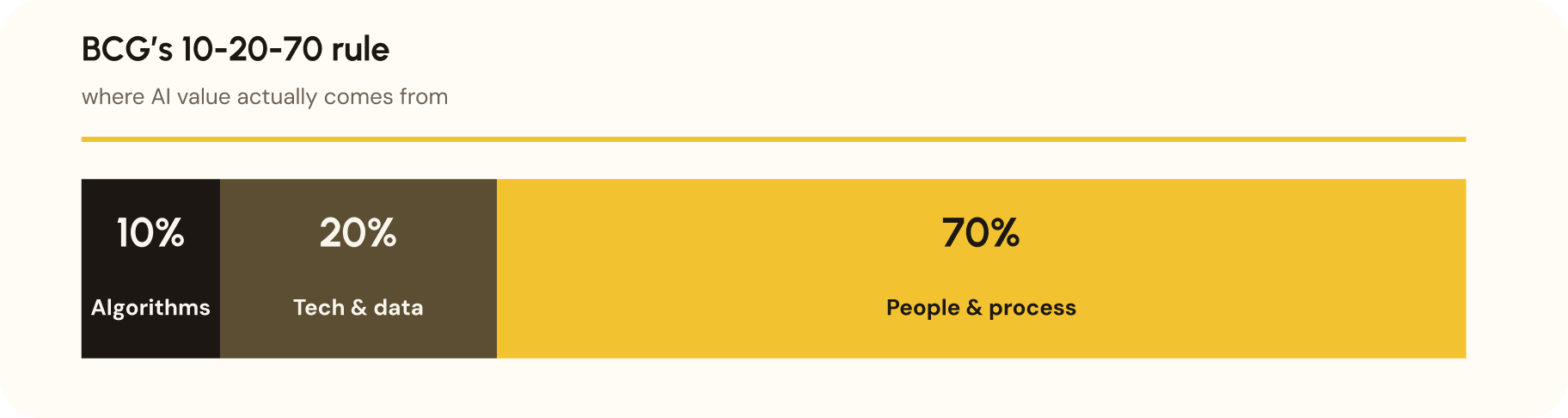
Most organizations invest in exactly the opposite proportion. When 80% of the budget goes to tools and the 70% human component gets ignored, the project stalls on cultural resistance, which 54% of executives now name as their top barrier to AI adoption. Four specific dynamics drive that resistance.
False alignment among leadership. Many transformations stumble before they start because the executive team never actually agreed on what the initiative was for. Some want cost cuts, others want growth, and the result is a set of uncoordinated, low-impact experiments running in parallel. Only 15% of employees say they’ve received clear, structured communication about the company’s AI strategy, and fewer than 30% of initiatives have real CEO-level sponsorship.
A skills gap wider than most executives realize. Only 36% of employees report having been trained on the skills needed to work in an AI-augmented role. Much of the training that does happen teaches tool awareness rather than the harder skill of knowing how to frame a problem, read model output critically, and recognize when to override it. High-maturity organizations upskill more than half their staff; lagging ones manage about 20%.
A quiet loss of professional pride. People resist AI when they think it’s coming for the parts of their job they’re actually good at and enjoy, whether that’s writing code, drafting copy, or building a financial model by hand. When AI gets framed as a replacement for that skill rather than support for it, employees tend to push back by finding exaggerated quality problems with the tool, whether or not those problems are real.
Emotions that leadership consistently misreads. 76% of executives believe their employees are excited about AI. Only 31% of employees actually say they are. Left unaddressed, that gap turns into fear of displacement: 46% of workers at companies actively redesigning around AI worry about their job security, compared to 34% at companies moving more slowly.
The organizations getting this right treat capability-building as core infrastructure, not a side project. Some have built real-time coaching agents that sit inside the actual workflow and guide employees as they work, which BCG found can accelerate impact delivery by up to 9x. The return on that investment is measurable: 98% of employees who go through structured AI upskilling programs go on to generate new, high-value use cases of their own, and 85% significantly increase how often they use AI tools day to day.
None of this works if it’s delegated entirely to a training team. The organizations where upskilling actually sticks are the ones where managers use the tools the same way their teams are expected to, in the open, including the parts where the model gets something wrong and someone has to catch it. That visible, ordinary use does more to build trust than any all-hands presentation on the AI strategy, and it’s also the cheapest fix on this entire list: it costs nothing but a manager’s willingness to go first.
A quieter reason AI initiatives fail is that most never establish a baseline in the first place. Teams launch a project without ever measuring the cost, speed, and error rate of the process they’re replacing, so there’s no way to know afterward whether the AI actually changed anything, whether the pilot succeeded, or what case to make to the executives who’d need to approve scaling it. That’s how so many projects end up in what practitioners call pilot purgatory: too promising to kill outright, too unproven to actually fund at scale.
The organizations that avoid this trap build a disciplined ROI framework before they build the pilot, structured around a straightforward formula:
Populating that formula means tracking four categories of value and one category of true cost.
Direct time saved: hours reclaimed by automating repetitive work, multiplied by active weeks per year and the fully loaded hourly cost of the employee doing that work.
Rework and errors avoided: the reduction in error rate, multiplied by monthly transaction volume and the cost of manually correcting a single error, annualized.
Revenue impact: the direct contribution of customer-facing AI to conversion, cross-sell, or churn prevention. If an AI lead-qualification model lifts conversion from 3% to 4% across 100 high-value monthly leads, that’s a number a CFO can act on.
Risk and compliance reduction: the reduction in probability of a violation occurring, multiplied by the cost of the fine or liability being avoided.
Total cost of ownership has to include more than the model’s API bill.
Pilot purgatory has a real cost even when nobody’s tracking it. A pilot that never gets a baseline still consumes engineering time, API budget, and executive attention every month it sits unresolved, and because nobody can prove it’s working, nobody can make the case to either scale it or kill it. Most organizations would rather let it quietly limp along than have the harder conversation about whether it should be shut down, which is exactly how AI budgets end up funding a portfolio of things nobody can defend in a budget review.
Organizations that pair this kind of measurement discipline with real workforce upskilling report an average return of $3.50 for every dollar invested in AI. JPMorgan Chase is a useful example of what this looks like in practice: the bank tracked adoption, time savings, and productivity gains on its “LLM Suite” platform from the very first week of rollout, and that discipline is part of why the tool scaled to 200,000 employees with benefits compounding 30% to 40% a year. Walmart did the same with operational metrics, documenting before-and-after numbers that showed its route-optimization AI eliminating 30 million unnecessary delivery miles, and its customer service AI cutting resolution times by 40%.
Once an organization gets past the pilot stage, the challenge shifts from proving value to keeping it under control. That means moving from static, once-a-year policy documents to governance that’s actually built into the engineering pipeline. Two frameworks, used together, cover most of what that requires: BCG’s Deploy-Reshape-Invent portfolio model for deciding what to fund, and Gartner’s AI Trust, Risk, and Security Management framework for keeping what gets deployed safe and compliant.
Deploy covers ready-made, off-the-shelf generative AI tools rolled out to lift immediate staff productivity, typically in the 10–15% range. The plays that work here prioritize quick-win workflows, buy rather than build, and focus on tracking adoption.
Reshape goes further: it redesigns an entire function, such as sales, customer service, or operations, around AI rather than bolting a tool onto the existing process. Instead of giving support agents a writing assistant, a Reshape play automates tier-one routing and self-service entirely, which can lift operational efficiency by as much as 50%.
Invent is the highest-risk, highest-reward tier: building genuinely new, AI-native products and business models. It requires board-level sponsorship, real long-term capital commitment, and the willingness to build defensible intellectual property rather than a workflow shortcut.
Underneath all three plays, Gartner’s TRiSM framework provides the technical guardrails needed to keep production systems trustworthy, structured around four areas.
Layered above both frameworks sits Enterprise Governance of AI: a cross-functional decision-making body that connects IT risk, data and analytics governance, and regulatory compliance under one executive-level umbrella. Its job is to make risk, value, and cost visible in one place, and to make sure every AI application is checked against external frameworks like the EU AI Act, the NIST AI Risk Management Framework, and ISO/IEC 42001.
Most organizations build governance backwards: they write a policy document, distribute it, and consider the job done, then discover during the InfoSec review described earlier that nothing in the policy was ever wired into the actual pipeline. Governance that holds looks different. It’s enforced automatically as part of the same CI/CD process that ships the model, which means a use case that violates a risk tier gets flagged before it reaches a customer, not after a regulator or a journalist finds it first.
None of this requires a multi-year transformation program to start. It requires a structured 90 days, broken into three phases.
Days 1–30: build the foundation. Name a single executive sponsor, whether that’s the CISO, CRO, CTO or CDO, who owns the AI registry and ensures every production model has a named owner. Audit the data feeding every active pilot against real AI-readiness standards. Document the baseline metrics, cycle time, error rate, and fully loaded labor cost, for every process before any pilot gets further funding.
Days 31–60: put controls in place. Classify every use case in the AI registry by risk tier, mapped to the EU AI Act and internal compliance thresholds. Build in the engineering controls, prompt validation and access controls, that address known LLM vulnerabilities, and connect drift and anomaly alerts directly to the development pipeline. Shift the build-versus-buy calculus toward vetted partners for specialized use cases, given the roughly 67% success rate on purchased vertical solutions against the far lower rate for internal builds. This matters even more for private-equity-backed businesses, where a typical 5.8-to-7.1-year hold period makes multi-year internal builds a bad bet from the start.
Days 61–90: enforce it. Turn on continuous TRiSM monitoring across every production endpoint to track drift, hallucination rates, and latency. Run a real financial audit comparing actual API, compute, and maintenance costs against the CFO’s cost-to-serve limits, and sunset anything that doesn’t clear the bar. Replace generic AI awareness sessions with structured enablement embedded in people’s actual daily work, focused on judgment, error detection, and how to work alongside the system rather than around it, with managers modeling the behavior themselves.

The pattern across every failure mode in this article is the same: AI doesn’t fail because the models aren’t good enough. It fails because organizations skip the unglamorous work of building the data, governance, and human capability that make the technology usable at scale. The 2% of pilots that survive the full path from funding to production to twelve months of operation are the ones that treated readiness as the actual project, and the model as one part of it.
None of the five production gates, the data foundation deficit, or the 10-20-70 imbalance described here are new problems in the abstract. Every one of them is a version of a challenge operations teams have solved before in other transformations: unclear ownership, missing baselines, under-invested change management, and controls added after the fact instead of designed in from the start. What’s different this time is the speed at which the gap compounds. A pilot that skips the data audit doesn’t just underperform quietly; it either dies in the InfoSec review six months later or, worse, makes it to production and fails in front of a customer or a regulator. The 90-day plan above is a way to find out early, on a small use case, whether the organization is actually ready to do this at scale, before the next $2 trillion in AI spending finds out the hard way.
Pilots typically get built fast on personal API keys, sample data, and a standalone interface, then hit five gates they weren't designed for: security review, real data access, integration into existing systems, true cost-to-serve economics, and dependency on a single model. Most die at one of those gates within the first year.
No. BCG's research puts only 10% of AI's value in the algorithm itself and 70% in people and process, the workflows, training, and decision rights around the tool. Most companies invest in the opposite proportion, which is why spend keeps rising while results don't.
Start with a baseline, not a bigger pilot. Name one executive owner, audit whether your data can support production (not just a demo), and document the cost, speed, and error rate of the process you're trying to improve before funding anything further. That baseline is what turns "we tried AI" into a case for scaling it. Check our AI-native business OS Scorecard to see where your biggest operational gaps are.





The AI Operating System Scorecard is a diagnostic tool that measures whether your business is structurally built to make AI compound, across nine dimensions including how decisions get made, how clearly your processes are defined and how your team is using and integrating AI.
The output is a clear view of where your biggest leverage gaps are and where to focus first.


One practical AI operating-system insight bi-weekly.
No fluff, no spam.

© 2026 AV Ventures Limited trading as Orbflo | All Rights Reserved