
Insights
/
Business Transformation
/
The AI Readiness Checklist: A Practical Assessment for SMEs Ready to Scale
Business Transformation

"AI readiness" sounds like an exam you can fail. In reality, it behaves more like a pre-flight check: a short list of things worth confirming before you put real weight behind an AI pilot. Get the six areas below into shape and a pilot has a genuine shot at becoming something the business actually runs on day to day. Skip them, and even a sound pilot tends to stall out somewhere between the demo and the day-to-day.
The research on this is more established than most founders expect. RAND's meta-analysis of 65 enterprise AI initiatives found that more than 80% failed to deliver lasting value, a rate about twice that of comparable non-AI IT projects. IBM's 2025 CEO Study, based on 2,000 CEOs across 33 countries, found a similar pattern at the very top of large organizations: only 25% report their AI initiatives delivering the expected return, and just 16% have scaled one past a single team or use case. These numbers describe enterprises with dedicated data science teams and seven-figure AI budgets. If they're stalling on execution rather than technology, the gap is rarely the model.
That's actually good news for a small or mid-sized business. SMEs don't carry the multi-layered approvals, regional data silos, or matrixed governance that slow enterprise AI programs down. A founder or a single operations lead can move a decision from Monday's meeting to Tuesday's build. What SMEs need instead is a short, honest check of a few structural things before scaling a pilot into daily operations. That's what this checklist is for. Run through it, see where you land, and use the diagnostic at the end if you want a more precise read.
There isn't one universal AI readiness standard. Large consultancies and platform vendors have each built their own: Gartner's AI-Ready Data Stack focuses on data fabric architecture and metadata management for enterprise-scale deployments. McKinsey's Rewired framework organizes digital and AI transformation around six core elements, from operating model design to embedding data across the business. Cisco's AI Readiness Index benchmarks organizations across six pillars and sorts them into Pacesetters, Chasers, Followers, and Laggards. Microsoft's AI Readiness Wizard and Salesforce's AI readiness tools both run assessments scoped tightly to their own platforms. Orbflo has published a full teardown of these models, including where each one is genuinely useful and where it overpromises, in 17 AI Maturity Frameworks Compared.
The enterprise-scale versions of these frameworks assume things most SMEs don't have and, frankly, don't need: dedicated data engineering teams, formal data governance offices, multi-region compliance functions. Applying one directly to a 20-person business tends to produce a checklist so heavy that nobody finishes it. A smaller set of SME-specific frameworks exists too, including Simam Digital's regional AI readiness checklist and a leadership-focused model published in Strategy & Leadership, and they converge on a narrower, more practical set of questions.
The pattern worth taking from this table isn't which framework wins. It's that SME readiness is a distinct problem from enterprise readiness, not a smaller version of the same one. The rest of this article works from the SME end of that spectrum.
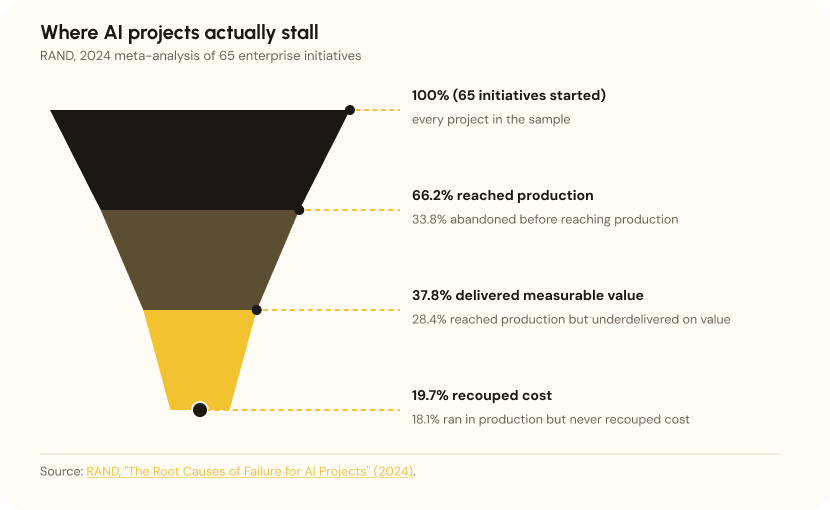
Remaining share reached production and delivered measurable value.
Two of those three failure modes happen before or right at the production line, not deep into operation. That's the window a readiness check is meant to catch.
A pilot with no named owner tends to drift once the person who built it moves on to the next thing. The businesses that get through this stage give one person, usually the founder or an operations lead, direct budget authority and a specific financial target to hit, something closer to "cut inbound ticket handling cost by 30% while holding CSAT above 85%" than "use AI more." They also write down, on a single page, what stops once the AI system starts: which manual steps, spreadsheets, or software seats get retired. Naming the trade-off up front is what keeps the win real instead of theoretical.
Pilots usually run on a clean, curated dataset someone assembled specifically for the test. Production runs on whatever the business actually has: CRM exports with duplicate contacts, invoices in three formats, customer records split across four tools. Before scaling, it's worth checking data against five plain qualities: complete, accurate, consistent, current, and relevant to the task at hand. Consolidating customer and transaction data into one trusted system of record, with a single ID per customer, tends to matter more to outcomes than any model choice does.
Pilots often run on scripts someone wrote in a rush to connect two tools together. Those scripts are usually the first thing to break under real volume. Moving to managed, documented API connections between core systems, with basic error logging and a cost alert on API spend, is unglamorous work that prevents most of the mid-scaling breakage. AWS publishes a solid, vendor-neutral five-step AI readiness checklist for SMBs that covers this integration layer in more technical depth.
Most SMEs don't need to hire a data science team. They need a short, honest map of which skills to hire for, which to build internally through hands-on training, and which to hand to an outside partner. Generic "AI 101" sessions rarely move the needle; training that's specific to a role, like teaching a support team how to review and correct an AI-drafted response, does. It's also worth setting a clear confidence threshold: the point at which the system hands a task to a person rather than pushing ahead on its own. A customer service tool routing to a live agent whenever its confidence drops below 80% is a common, sensible version of this.
This is the area most SMEs underinvest in, mostly because it sounds like something only large enterprises need. It doesn't have to be heavy. The NIST AI Risk Management Framework organizes the whole thing around four functions: govern (name someone accountable for AI risk), map (keep an inventory of what tools touch what data), measure (check output quality on a regular cadence), and manage (write down what happens if something breaks).
If customers are in the EU, two dates matter now: the Act's transparency rules, requiring clear disclosure when someone is talking to an AI system, became enforceable on 2 August 2026, while the compliance deadline for higher-risk systems (things like automated hiring screens or credit decisions) was pushed back to December 2027 under the EU's Digital Omnibus package. SMEs and start-ups under 750 employees also get a meaningful protection here: Article 99 caps their fines at the lower of the fixed amount or the turnover percentage, where larger companies face the higher of the two.
The last check is the softest and often the one that decides whether people actually use the system once it's live. A simple, visible way for staff to flag when the AI got something wrong, reviewed weekly rather than left to pile up, does more for adoption than any launch announcement. Naming the system's limits out loud, what it's good at and what still needs a human, tends to build more trust than pretending it's flawless.

This is the condensed, printable version. Twenty checks across the six areas above. Answering "yes" to most of them puts a business ahead of where the research suggests most organizations, including much larger ones, actually sit before they scale.
There's no pass mark here, and that's the point. A checklist like this measures direction. A business that checks fourteen of twenty boxes is in a genuinely strong position to scale carefully; one that checks eight still has a clear, short list of what to fix next rather than a vague sense that "AI hasn't worked yet." Either way, the value is in knowing which specific areas need attention before more budget and more workflows get built on top of the pilot.
For a more precise, weighted read, the Orbflo AI Operating System Scorecard scores a business across nine dimensions, including decision authority, data readiness, and process clarity, and shows exactly where the biggest gap sits. The research behind why those nine dimensions were chosen, instead of the simpler usage metrics most AI maturity tools default to, is covered in The Research Behind the AI-native Business Operating System Scorecard.
Where to start
The checklist above takes ten minutes and gives a directional read. The AI Operating System Scorecard takes the same starting point further, scoring your business across nine capabilities and showing exactly where to focus first.
A readiness checklist is a point-in-time check of whether the basics are in place before you scale a specific pilot: ownership, data, systems, team, governance, and culture. A maturity model, like the ones compared in 17 AI Maturity Frameworks Compared, tracks how a business's overall AI capability develops over a longer stretch of time. Readiness checks are the entry point. Maturity is the ongoing measure.
Based on the structured roadmaps used by SME-focused frameworks, a realistic timeline runs about 12 to 20 weeks: roughly a month to set a baseline and appoint an owner, six to eight weeks to clean up data and systems, and another six to eight weeks to put governance and training in place before a full launch. Businesses with cleaner data and a single clear owner from day one often move faster than that.
Yes, if the AI system affects people in the EU. Article 2 sets the Act's territorial scope based on where the effects land, not where the company is headquartered, so a US or UK-based SME serving EU customers through a chatbot or an automated decision tool still falls under its transparency and, where applicable, high-risk requirements. Businesses that only trade domestically outside the EU aren't in scope.





The AI Operating System Scorecard is a diagnostic tool that measures whether your business is structurally built to make AI compound, across nine dimensions including how decisions get made, how clearly your processes are defined and how your team is using and integrating AI.
The output is a clear view of where your biggest leverage gaps are and where to focus first.


One practical AI operating-system insight bi-weekly.
No fluff, no spam.


© 2026 AV Ventures Limited trading as Orbflo | All Rights Reserved