
Insights
/
Business Transformation
/
Where AI Agents Are Paying Off: Three SME Workflows With Verified ROI
Business Transformation

Most of what gets written about AI agents in small and medium businesses falls into one of two buckets: breathless vendor case studies with no way to check the numbers, or failure-rate statistics with no path forward. Neither is much use if you're actually trying to decide what to automate next.
So this piece does something narrower. It looks at three specific workflows, missed-call handling, accounts receivable, and invoice processing, where the ROI numbers trace back to a named company and a checkable source. It's a look at where AI agents demonstrably work, what the architecture behind each one actually looks like, and what the failed attempts around them got wrong.
Starting with the discouraging part, IBM's 2025 CEO Study, based on a survey of 2,000 CEOs across 33 countries, found that only 25% of AI initiatives have delivered the ROI leadership expected, and just 16% have scaled past a pilot to run across the enterprise. Gartner's April 2026 survey of 782 infrastructure and operations leaders found much the same pattern one layer down: only 28% of AI use cases in that function fully succeed and meet ROI expectations, while 20% fail outright. We've written before about why most AI pilots never make it to production, and separately why agent adoption specifically stalls at the same point. The short version: buying the tool was never the hard part.
What the failure statistics don't show is that the successes cluster. They're not spread evenly across every possible use case. They show up disproportionately in workflows with three traits: high transaction volume, a clear right answer, and a defined point where a human needs to take over. Missed-call handling, collections, and invoice processing all have this shape. And it's the reason these three keep appearing in verifiable case studies while broader "transform the whole business with AI" projects keep stalling.
The economics here are blunt. Missed calls are estimated to cost the average small business somewhere in the tens of thousands of dollars a year in lost revenue, and even conservative studies put the share of small-business calls that go unanswered well above a third once you account for after-hours and peak-volume periods. Speed compounds the problem: research from the Lead Response Management study popularized by InsideSales.com found that contacting a lead within five minutes makes it roughly nine times more likely to convert than a response thirty minutes later. Most small businesses, staffed by a single receptionist or an owner answering their own phone, simply can't hit that window consistently, especially outside business hours.
The fix that's working is a voice-enabled agent that sits in the same place a receptionist would: answering the call, extracting what the caller needs, checking it against a set of qualifying rules, and booking the appointment directly into the calendar and CRM.

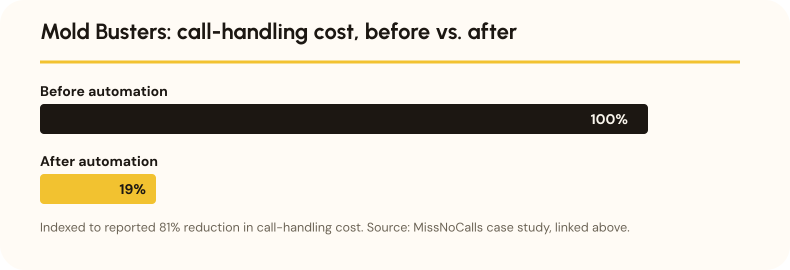
The clearest documented example is Mold Busters, an environmental remediation company that deployed a voice agent (built on MissNoCalls' platform and nicknamed "Bruce" internally) to handle inbound calls around the clock. The published case study reports call-handling costs down 81%, response time cut from around five minutes to under ten seconds, a 75% increase in after-hours responses from day one, and a 20% lift in conversion rate.
What made it work, according to the same case study, was voice clarity and calendar sync, not scale or sophistication. What didn't work, in an earlier iteration described in the underlying research, was letting the agent handle emotionally charged disputes, like a customer unhappy with a prior inspection. Those calls need a person, immediately, and the businesses that got this right built the handoff rule in before launch rather than patching it in after a bad call went viral internally.
Accounts receivable is a strange corner of the business to automate, because the money is already earned. It's sitting in an invoice, waiting on a phone call or an email that a finance team hasn't had time to send. Finance teams commonly report spending a large share of their working hours on manual invoice follow-up, reconciliation, and reminders, which is exactly the kind of repetitive, rules-based work that doesn't need a person doing it by hand.
The automated version of this workflow scores each customer's payment behavior, sequences reminders based on that risk score rather than treating every account the same, and reconciles incoming payments against invoices automatically. Two case studies from Billtrust, an accounts receivable platform, show what that looks like in practice.
Sources: Billtrust, Peak Industrial case study; Billtrust, McPherson Oil case study.
Peak Industrial's win came largely from prioritization: instead of chasing every overdue account in order of size or age, the system focused collections effort on the accounts most likely to actually pay late, based on behavioral history. McPherson Oil's gain came from a different lever, pushing more customers onto automated ACH collection so the finance team could shift from data entry to proactive outreach on the accounts still at risk.
The failure mode worth naming here is a coordination one, not a technical one. In earlier deployments described in the underlying research, automated payment reminders kept going out to customers who had already opened a billing dispute through a separate support channel. The agent didn't know the dispute existed, so it kept nudging a customer who was already annoyed. The fix isn't a smarter model, it's making sure the collections agent and the dispute-tracking system talk to each other in real time, so outreach pauses automatically the moment a dispute is logged.
Manual accounts payable work is slow in a specific, countable way. Industry estimates put manual invoice processing cost somewhere between $12 and $35 per invoice, with a full cycle from receipt to payment often taking two to three weeks. Multiply that by a few thousand invoices a year and the number gets uncomfortable fast.
Komatsu Australia's parts division is a useful example precisely because it's unglamorous: a small team was manually keying nearly 52,000 invoices a year. Using Microsoft Power Automate paired with AI Builder for document extraction, the company automated invoice ingestion and reached production within four weeks of purchasing the licenses. The documented result was 300 hours of manual data entry saved annually for a single supplier alone, with the team planning to extend the same setup across the rest of its supplier base.
The pattern that made this work is the same one showing up across all three workflows: the agent handles the volume, and a defined rule decides what gets flagged for a person. In AP specifically, that usually means routing anything with a low extraction-confidence score, or anything above a set dollar threshold, straight to a human for approval instead of letting it post automatically. Early attempts elsewhere that skipped this step, and let mismatched invoices post directly into the accounting system, created exactly the kind of accounting mess that makes finance teams distrust automation for years afterward.
Line these three workflows up and the pattern becomes more about how narrowly the problem was scoped before anyone touched a model.
Every one of these deployments started with a process that was already standardized, instead of a process being cleaned up on the fly by the agent itself. That matters more than it sounds like it should. If a business's customer onboarding, invoice coding, or dispute-handling already varies by whoever's doing it that day, an AI agent doesn't fix the inconsistency, it just executes it faster and at scale. We've written about this in more depth in our practical blueprint for redesigning processes for AI: the redesign has to come before the automation, not after it.
Every one also had a deterministic escalation rule decided in advance. A disputed invoice, an angry caller, a mismatched line item: these get routed to a person, automatically, every time, based on a rule someone wrote down before launch. None of the three case studies above ran the agent at 100% autonomy from day one.
And in each case, the model doing the work was matched to the complexity of the task. Voice-to-text and rules-based qualification for call handling. Risk scoring and reconciliation matching for collections. OCR paired with a language model for document extraction. None of these needed a large, expensive reasoning model running on every transaction, which matters because burning premium compute on a task simple enough for a template is its own quiet way to kill the ROI case.
There's a deadline sitting inside this conversation that's easy to miss if you're focused purely on ROI. The EU AI Act's Article 4 obligation, requiring businesses to demonstrate a baseline level of AI literacy among staff who build or use AI systems, entered into force in February 2025. What changes now is enforcement: national market surveillance authorities begin supervising and enforcing that obligation on 2 August 2026. If you're reading this in late July, that's days away, not a distant compliance item to revisit next quarter.
Most of what a small business runs, internal code assistants, spam filters, recommendation logic, falls into the Act's minimal-risk tier and carries no obligations beyond basic staff awareness. Anything customer-facing, like the call-answering agents described above, sits in the limited-risk tier and needs a clear disclosure that the customer is talking to an AI. Only a narrow set of use cases, like automated CV screening or credit decisioning, hit the high-risk tier that requires formal conformity assessments.
None of this requires an expensive compliance consultancy to sort out. A short internal inventory of which tools use AI, a couple of pages defining what data staff can and can't put into a public model, and a folder of screenshots and training records covers most of what a small business actually needs to show if asked.
The businesses in the case studies above didn't automate their whole operation at once. They picked one workflow, ran it for thirty days as a diagnostic before writing a line of automation, then built a narrow pilot, then connected it to the surrounding systems, then added the escalation rules, then trained staff and documented the setup. That order matters more than the tools chosen at each step.
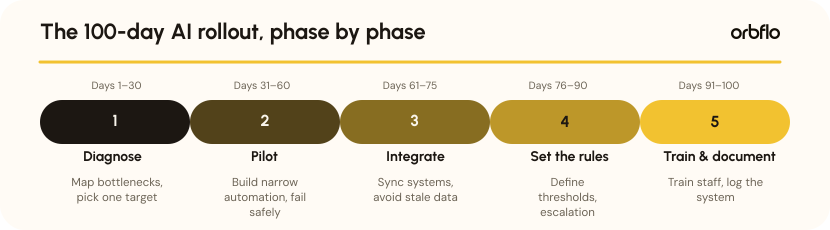
Track manual tasks, map the top three bottlenecks by time spent, pick one high-volume, low-complexity target.
Build the narrow automation, connect it to a single workflow, keep it small enough to fail safely.
Sync the agent bi-directionally with the CRM, ERP, or dispute system so it isn't acting on stale information.
Define confidence thresholds and escalation paths before scaling volume.
Run staff literacy training, log the system inventory, and confirm the audit trail exists.
Where to start
Every workflow above worked because the underlying process was already clear enough to hand to an agent. The AI Operating System Scorecard measures exactly that, across nine dimensions including data readiness, process clarity, and how your team is actually using AI today, so you know which workflow is genuinely ready before you build anything.
Start with whichever one already has the most standardized process behind it, not whichever seems the most impressive. Missed-call handling tends to be the fastest to stand up because it doesn't require deep integration with financial systems. AR and AP automation pay back faster in dollar terms but need cleaner underlying data and tighter system integration before they're safe to run unsupervised.
Mold Busters and McPherson Oil are exactly the size of company most of this content is written for, not enterprise giants with in-house AI teams. Komatsu Australia is larger, but the workflow it automated, invoice ingestion for a single supplier, was scoped down to something a much smaller team could replicate. The pattern that produced the ROI (narrow scope, clear escalation rules, matched model complexity) doesn't require enterprise scale to apply.
It applies to any business whose AI systems are used by people in the EU, regardless of where the company itself is based, so a US or UK company selling into EU customers through an AI-powered chatbot or voice agent falls under it. Given enforcement starts within days of this article's publication, it's worth a short conversation with legal counsel rather than an assumption either way.





The AI Operating System Scorecard is a diagnostic tool that measures whether your business is structurally built to make AI compound, across nine dimensions including how decisions get made, how clearly your processes are defined and how your team is using and integrating AI.
The output is a clear view of where your biggest leverage gaps are and where to focus first.


One practical AI operating-system insight bi-weekly.
No fluff, no spam.


© 2026 AV Ventures Limited trading as Orbflo | All Rights Reserved