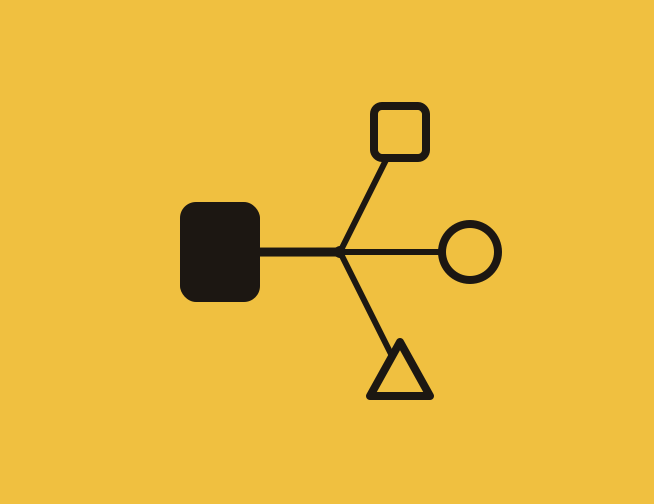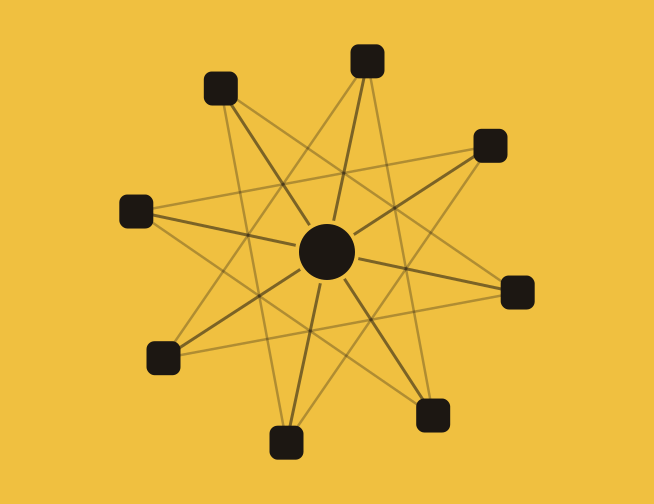
Most conversations about business AI still picture a single chatbot answering one question at a time. The systems now moving into production look nothing like that. They're networks of specialized agents, one drafting, one verifying, one filing, one escalating, coordinating on a shared task the way a small team would. And the gap between businesses experimenting with this pattern and businesses running it in production is the widest, most consequential number in enterprise AI right now: 79% of organizations report adopting or experimenting with AI agents, but only 11% have gotten one into live production, and just 6% of early implementations show a measurable return within their first twelve months.
That 68-point gap between adoption is an architecture problem. The research on what separates the 11% from everyone indicates that the core culprits are orchestration topology, communication protocols, memory design, human oversight, and governance, the unglamorous plumbing that determines whether a multi-agent system is a demo or a business process. Nothing suggests this it is about which foundation model a company licenses.
Every multi-agent system has to answer one design question before anything else gets built: who's in charge, and how do the agents talk to each other? There are three established patterns, and each trades control for scale in a different direction.
A centralized topology puts a single supervisor agent in charge. It receives the request, breaks it into subtasks, hands each piece to a specialized subagent, and stitches the results back together. Every decision passes through one point, which makes the system easy to audit and debug: there's a single, linear trail of who did what and when. The tradeoff shows up at scale. Once a system grows past roughly ten to twenty subagents, the supervisor itself becomes the bottleneck, and because it's the only coordinator, it's also a single point of failure. If it crashes or locks up, the whole workflow stops with it.
A decentralized topology removes the single coordinator entirely. Agents operate as peers, reacting to events the way independent microservices do: a payment service completes a transaction and publishes an event, a warehouse service picks it up and prepares shipping, a delivery service takes over from there, with no central conductor telling any of them what to do next. This scales well in high-volume, distributed settings, but it comes at a real cost to visibility. Without a central ledger, tracing why something went wrong, or stopping a runaway process before it cascades, gets substantially harder.
Most production systems now split the difference with a hybrid approach: a central planner governs the high-level workflow and the points where a transaction has to be gated or logged, while specialized agent clusters handle their own domain independently underneath it. An AI sales assistant might centrally orchestrate lead qualification while letting enrichment, CRM updates, and calendar scheduling run as independent, event-driven side processes. It's more moving parts than either pure pattern, but it's what production compliance and audit requirements tend to demand.
Two further variants show up often enough to name. In a blackboard system, agents don't message each other directly at all. They read and write to a shared workspace, contributing partial answers as they become available, which lets specialists work asynchronously rather than waiting in a fixed sequence. A recent Google Research study found blackboard architectures beat both standard retrieval-augmented generation and simple master-slave multi-agent setups by 13% to 57% on end-to-end task completion, a meaningful spread that held up across different underlying models. Hierarchical systems, meanwhile, mirror an org chart: senior agents set strategy, delegate to mid-level managers, who coordinate stateless execution agents underneath them. That structure keeps communication overhead from growing quadratically as more agents join, and it contains failures at the level where they happen instead of letting them escalate straight to the top.
Underneath any of these topologies sits a development framework, and the six leading options are not interchangeable. LangGraph models workflows as explicit directed graphs with checkpointed state, which makes it the choice for fine-grained, auditable control. CrewAI maps agents onto human team roles, which makes it fast to prototype but less rigorous about state. AutoGen (AG2) treats coordination as a conversational group chat between agents, good for debate-style problem solving. Google's ADK is built around hierarchical agent trees and is optimized specifically for Gemini models with native agent-to-agent protocol support. OpenAI's Agents SDK uses explicit handoffs between agents with minimal boilerplate, tied to OpenAI models. Anthropic's Claude Agent SDK chains tool use through subagents with MCP-based state persistence, and leans into extended reasoning and direct computer control.
As multi-agent systems move across teams and vendors, they need standard ways to talk, and three open protocols now define those boundaries. Anthropic released the Model Context Protocol (MCP) in November 2024 as a vertical standard connecting a model to the tools and data it needs, with open-source SDKs and pre-built servers for Google Drive, Slack, GitHub, and Postgres among others. It governs how a model reaches down into its own toolbox.
Google announced the Agent2Agent (A2A) protocol in April 2025 and donated it to the Linux Foundation that June, establishing it as a vendor-neutral standard now backed by more than 150 organizations including AWS, Cisco, Microsoft, Salesforce, SAP, and ServiceNow. A2A is horizontal rather than vertical: it lets independent agents built on completely different frameworks, LangGraph talking to AutoGen talking to CrewAI, discover each other's capabilities through published "Agent Cards" and collaborate without exposing their internal databases or logic to one another.
IBM Research's Agent Communication Protocol (ACP), built for its BeeAI platform, takes a lighter-weight approach: plain REST calls with agent metadata embedded via standard MIME types, trading some of A2A's structure for immediate compatibility with existing web infrastructure.
These aren't rival standards competing for the same job. MCP handles the vertical connection between a model and its tools. A2A and ACP handle the horizontal connection between independent agents. A production system typically needs both layers working together, not a choice between them.
Letting a model plan a complex, multi-step task in a single pass introduces compounding errors the longer the task runs. The more structured alternative is a Hierarchical Task Network (HTN): predefined methods, preconditions, and effects that break a high-level goal into a network of smaller, verifiable steps. It's a sharp contrast to Tree of Thoughts (ToT), which explores several candidate solution paths in parallel and scores them, a technique that shines on open-ended problems like proofs or scheduling puzzles but burns tokens fast and produces less predictable output.
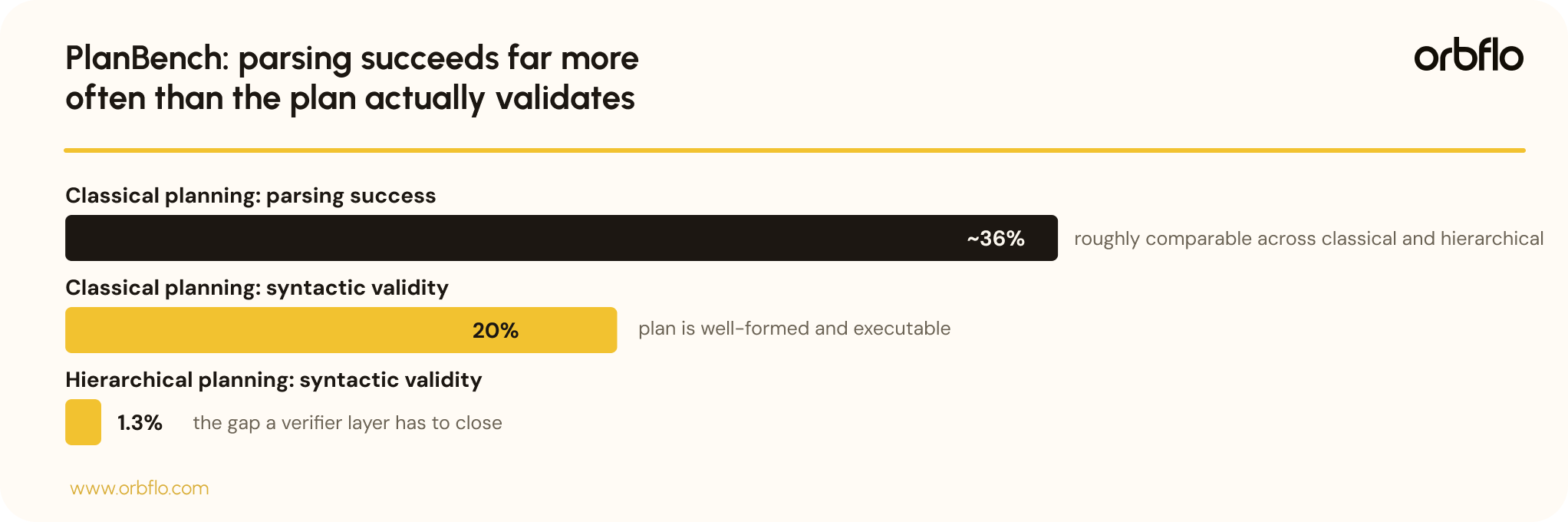
The gap between theory and execution here is wider than most teams expect. On the PlanBench benchmark, a study testing whether reasoning models can replace classical planners found that parsing success hovers around 33% to 40% for both classical and hierarchical plans, roughly comparable, while syntactic validity sits at about 20% for classical plans versus just 1.3% for hierarchical ones. Syntactic validity measures whether the parsed plan is actually well-formed and executable. Models are reasonably good at producing something that looks like a plan. They're much worse at producing a hierarchical plan a machine can actually execute without a human fixing it first.
This is precisely why production planning architectures pair a generative model with an external, symbolic verifier rather than trusting the model's plan outright. In the LLM-Modulo approach, when a model proposes a sequence of actions, a separate verifier checks it against real business and physical constraints; if it fails, the verifier returns a concrete counterexample and forces a revision, looping until the plan actually holds up. The model proposes. Something else that isn't a language model checks the work before it runs.
The most common reason multi-agent systems fail in production has nothing to do with model intelligence: agents pass each other raw, unstructured text or loosely-typed JSON, field names drift, formats mutate, and every downstream agent is left guessing at what the upstream one actually meant. The fix is to treat the whole workflow as a formal state machine, where every message between agents has to match a typed schema (defined with something like Pydantic or TypeScript interfaces) before it's accepted, and every agent's possible actions are limited to an explicit, predefined set. An agent that can only choose from "request more info," "assign a ticket," or "close a case" cannot invent a fourth option. That constraint is a feature.
Underneath the schema sits a memory hierarchy with four distinct layers: working memory (the live context window, holding the current task), episodic memory (a durable log of what already happened, for tracing and auditing), semantic memory (the business's own definitions, policies, and domain knowledge), and procedural memory (the catalog of tools and workflows an agent is actually allowed to use). Skipping the design of any one of these layers is how a system that works in a demo starts hallucinating in week three, once the working memory fills up with context nobody structured.
A frequently cited engineering maxim in this space is blunt: state is king. The architecture of a multi-agent system is defined by the schema of its state; the model itself is a transient function that transforms that state from one step to the next. Teams that treat state design as an afterthought, and spend all their design energy on prompts instead, are the ones who end up debugging a system nobody can fully explain.
As these systems move from generating content to executing real transactions, the focus become where, and how tightly to keep a human in the loop. Three patterns map roughly to risk level. Human-in-the-loop halts the workflow at a checkpoint and waits for explicit approval before continuing, appropriate for anything irreversible: contract execution, payment routing, data deletion. Human-on-the-loop lets agents run autonomously while a person watches a live dashboard with override authority, suited to lower-stakes but still meaningful decisions. Human-out-of-the-loop runs fully autonomously inside tight, predefined boundaries, reserved for high-volume, low-risk, easily reversible actions.
A documented loan-approval workflow built on Orkes Conductor is a clean illustration of why the routing matters more than the automation itself. The decision engine scores its own confidence: a high-confidence application auto-approves or auto-rejects, but a low-confidence score or a flagged edge case, an unusual income pattern, missing documents, a borderline credit score, routes straight to a human reviewer instead. The documented cases where that matters are specific: the automated workflow alone might approve an unusually large loan it shouldn't, or reject a loyal customer over nothing more than a missing middle name. A human overriding the default outcome in those moments is what preserves a good customer the automated baseline would otherwise have turned away.
To make synchronous approvals workable at scale, systems typically emit a structured approval request, serialize the workflow's exact state to a database, and pause, resuming only once a human (via email, a Slack alert, or a review portal) returns a decision. A common design pattern adds timeout handling on top: if a queued request sits untouched too long, it automatically reroutes to a second reviewer, and past a further threshold, the system defaults to a safe rollback rather than leaving a transaction in limbo indefinitely.
Most AI observability tools, OpenTelemetry, Langfuse, and similar, capture what an agent did after it already did it. That works great for a chatbot answering questions but it doesn't work at all for an agent with write access to a database, a payment gateway, or a customer's inbox, where post-hoc detection means the violation has already happened by the time anyone sees the log.
Apple Machine Learning Research's Governance-Aware Agent Telemetry (GAAT) framework, published in 2026, addresses this by intercepting an agent's decision before it reaches the downstream system, not after. It works through four layers: a telemetry schema that tags every agent message with its business domain, data lineage, and applicable regulatory controls; a real-time policy engine evaluating that data against declarative rules; a governance enforcement bus that can alert, modify, escalate to a human, or flatly block an action before it executes; and a cryptographically signed audit trail that can't be tampered with after the fact. In testing across 5,000 synthetic policy-violation attempts, the architecture prevented 98.3% of them, with a median detection time of 8.4 milliseconds and a median end-to-end enforcement time of 127 milliseconds, fast enough to sit in the critical path without becoming the bottleneck itself.
The attack surface this is defending is wider than most teams initially map. Security frameworks like AgenticCyOps break agentic risk into three layers: the components themselves (a prompt injection, an insecure local tool), the coordination between agents (state pollution, one agent stuck feeding another agent bad context in a loop), and the protocols connecting them (an unauthenticated A2A or MCP request slipping through). A governance plan that only covers one of the three leaves the other two open.
Small and mid-sized businesses and large enterprises are fighting two different versions of this problem. SMEs are usually held back by cost, aging infrastructure, and the absence of in-house data science talent, while running manual processes that are already quietly expensive: manual invoice processing carries error rates near 20%, versus 94% to 96% first-pass accuracy, a 4% to 6% error rate, for AI-assisted categorization, and invoice errors sit behind the majority of late payments, with close to three in five small businesses carrying invoices overdue by 30 days or more. The practical answer for a lean business is rarely custom-built AI. It's low-code and managed middleware plugged into the CRM or bookkeeping platform already in use, aimed squarely at high-frequency, deterministic work: chatbots deflecting up to 80% of routine service inquiries, automated invoicing cutting prep time by 60% to 80%, agents wired to inventory data automating reordering.
Large enterprises run into a different wall entirely, sometimes called the "action gap": the friction between probabilistic AI output and the rigid, deterministic core systems, the ERP, the CRM, the ledger, that a business actually runs on. A model can return a slightly different format from the same prompt twice; a payment system cannot tolerate that kind of variance. Bridging it means wrapping the probabilistic model in deterministic guardrails: machine-readable API contracts that reject malformed requests before they touch a backend, a central registry of every agent in the business so nothing unvetted proliferates across departments, and zero-copy data access that lets an agent query a system of record directly instead of duplicating sensitive data into a new, less-governed location.
Salesforce's Data 360 platform, integrated with Amazon Redshift, is a live example of that last piece: agents query large volumes of client data in place, without ever copying or moving it, preserving data residency and security requirements that would otherwise block the integration entirely. The same zero-copy foundation supports Data 360 Clean Rooms, letting separate organizations analyze a combined, privacy-safe view of shared data, retail partners measuring campaign performance together, for instance, without either side seeing the other's raw records.
The theory matters less than what's already shipped and measured. A handful of well-documented deployments show where this pattern earns its keep, and where it still needs a human backstop.
Klarna is the case worth sitting with longest, because it cuts against the simplest version of the story. The initial numbers were genuinely striking: a workload equivalent to hundreds of full-time agents, response times cut by more than 80%. But CEO Sebastian Siemiatkowski later acknowledged publicly that the company had cut too far, and by mid-2025 Klarna was rehiring human agents specifically to handle the complex, nuanced cases the AI kept getting wrong, moving toward a model where a customer can always reach a person. This is the tier-based oversight model this article keeps returning to, tight bounds on routine work, a real human path for everything else. This is what sustaiable deployment looks like, not an optional infrastructure choice.
Across all six cases, the pattern repeats: the highest returns come from re-engineering a workflow around human-AI collaboration rather than bolting AI onto one step of an unchanged process, and the projects that stayed healthy were the ones measured by a real business metric, hours saved, miles eliminated, dollars recovered, instead of measuring how many actions the agents technically performed.
A rollout's true cost rarely shows up in the model's API bill alone. The Total Cost of Work (TCoW) framework aggregates human salaries, contractor fees, and every layer of digital labor cost, model fees, hosting, vector storage, licensing, onto one comparable basis, because freeing up 20% of an employee's time through automation does not translate into a 20% cost reduction once the ongoing cost of running that automation is counted honestly.
The failure modes worth planning for ahead of time are specific and recurring. State decay and cascade errors: a small formatting slip upstream, a JSON response wrapped in markdown backticks, crashes a downstream parser and stalls the entire sequence. Runaway delegation: a supervisor with a vague tool description falls into a loop, repeatedly calling the same subagent to resolve an error it can't actually resolve, burning real money in API calls within minutes if nothing catches it. Model and prompt drift: providers retrain and update foundation models continuously, and an unannounced shift in a model's reasoning pattern or output format can break an interface that was validated and working last month. Brittle UI automation: agents that click through a web interface directly break the moment a button moves, and while an intelligent agent may adapt rather than crash outright, adapting sometimes means hallucinating a workaround that wasn't intended.
A practical guard against the second failure mode is a simple loop-detection watchdog: if any agent or tool gets invoked more than three times for a single subtask, the system throws an exception, pauses, and alerts a human, rather than letting the loop run unattended until someone notices the bill.
None of this requires a company to build its own orchestration framework from scratch. It requires getting three decisions right before the first agent goes live:
(1) Data engineering is the actual moat, not model access: every major foundation lab sells access to comparable model quality, so the durable advantage is the quality, lineage, and structure of a business's own data feeding those models.
(2) The shift has to be from prompt engineering to a real control plane: treat natural-language prompts as one function inside an explicit, typed state machine, not as the architecture itself.
(3) Governance has to be active and inline, not a dashboard reviewed after the fact: a policy engine that can block or escalate an action before it commits to a live system is the only version of oversight that actually prevents the damage instead of only documenting it afterwards.
For a business without a dedicated AI engineering team, that translates into an honest starting sequence: map which one workflow is worth automating first and what its real error rate and cost look like today, decide up front which of the three human-oversight tiers each part of that workflow actually needs, and put a typed, schema-validated boundary between any agent and your live systems of record before a single agent gets write access to anything that matters.
A single chatbot handles one conversation at a time within one context window. Multi-agent orchestration coordinates several specialized agents, each handling a different part of a task, the way a small team divides work, and it requires an explicit architecture (centralized, decentralized, or hybrid) to decide who's in charge and how the agents communicate reliably.
Centralized orchestration routes every decision through one supervisor agent, which is easy to audit but bottlenecks past 10 to 20 agents. Decentralized orchestration lets agents act as independent peers reacting to events, which scales well but is harder to debug and monitor. Hybrid orchestration, the pattern most production systems now use, keeps a central planner for high-level workflow control while letting specialized agent clusters execute independently underneath it.
The research points to architecture, not model quality: 79% of companies report adopting or experimenting with AI agents, but only 11% have them in live production. The common failure causes are unstructured communication between agents instead of typed schemas, missing human-oversight tiers matched to actual risk, and governance that only checks what happened after the fact instead of before an action executes.





The AI Operating System Scorecard is a diagnostic tool that measures whether your business is structurally built to make AI compound, across nine dimensions including how decisions get made, how clearly your processes are defined and how your team is using and integrating AI.
The output is a clear view of where your biggest leverage gaps are and where to focus first.


One practical AI operating-system insight bi-weekly.
No fluff, no spam.

© 2026 AV Ventures Limited trading as Orbflo | All Rights Reserved